
An Excerpt from Shepherd on the Hill: A Patriot Pastor’s Guide to Capitol Ministry,
by David Armstrong
“And Jesus answering said unto them, Render to Caesar the things that are Caesar’s, and to God the things that are God’s. And they marvelled at him.” ~Mark 12:17~
Jesus and the early church lived in a world of kings, proconsuls, and emperors. Caesar was supreme, even worshipped. Since that time, many dynasties of great rulers have born the title. In Pre-Communist Russia, they were the Czars. In Germany prior to the first World War, they were the Kaisers. What do we have in the United States? Who is Caesar in our country? The first inclination of many people is to say, “The president is like a Caesar,” but that is not the answer. The answer is very simple: you are Caesar! The United States of America is an experiment in self-government that is utterly unique in all of world history. Dr. David Ramsay wrote in his Fourth of July Oration in 1794,
We have hit a happy medium between despotism and anarchy. Every citizen is perfectly free of the will of every other citizen while all are equally subject to the laws. Among us no one can exercise any authority by virtue of birth. All start equal in the race of life. No man is born a legislator. We are not bound by any laws but those to which we have consented.[1]
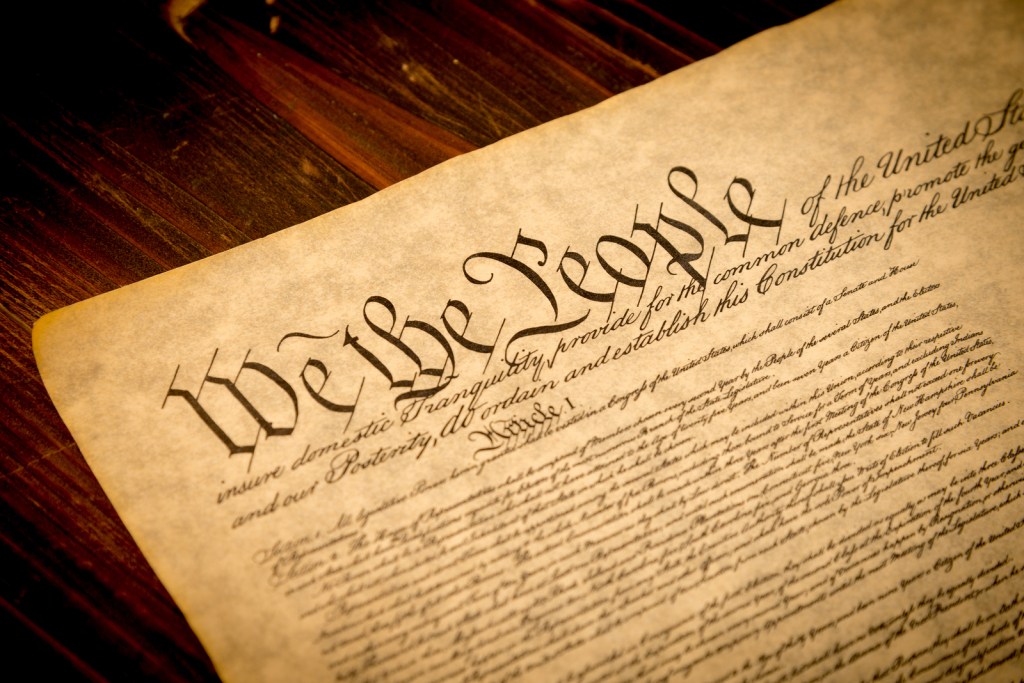
In our nation, the people govern themselves, via representation, according to a supreme law of our land: the United States Constitution. We are not a democracy, as many believe today. We are a republic. Our U. S. Constitution requires that we elect our governing officials at regular intervals to ensure that we are always governed according to that same supreme law. We the People are Caesar, and we choose who represents us in government. If elected officials are not governing in accordance with the Constitution, we have the opportunity every two, four, and six years to replace them. Every two years, we elect our representatives. Every four years, we elect a president. Senators serve a six-year term, with one third being elected every two years. One critical function necessary to such a representative republic is the involvement of godly people. If we as believers do not like the government, then we must begin by blaming ourselves.
In our nation, government was designed to have the input of the citizens, but the responsibility of self-government required thriving churches. John Adams said, “Our constitution was made only for a moral and religious people. It is wholly inadequate to the government of any other.”[2] He understood that the kind of unprecedented liberty protected by the high ideals of self-government could only be preserved if the people being governed were morally and spiritually mature enough to handle it. In other words, freedom relies on the Christian. George Washington himself said, “There is a natural and necessary progression, from the extreme of anarchy to the extreme of tyranny; and arbitrary power is most easily established, on the ruins of liberty abused to licentiousness.”[3]
What must be done to ensure that liberty is not “abused to licentiousness”? To begin with, churches must be strong and free, preaching the Gospel and discipling new converts. They must render unto God the things that are God’s. This duty provides the necessary character of the nation. In the early days, public policy was very much defined in the pulpit. Pastors preached the Word of God while politicians in the pews heard that preaching and applied those principles and truths in office. Today, we must continue to communicate with those who represent us in government. They must be aware of how we would have them govern, and we must hold them accountable. Author Chuck Colson contrasts Christian influence with the worldly influence of partisan constituencies. He writes, “Our message is not, ‘We put you in office, now pay up.’ Rather it is, ‘This should be done because it is right; it is a principle that undergirds any well-ordered society.’ We must be clear that the moral positions we urge are not partisan; they apply to Democrats and Republicans alike.”[4] These are the things that must be rendered unto Caesar. In this representative republic, Caesar requires the input of God’s people. For Christians to not be involved in the United States’ government is to shirk responsibility. In fact, since government is itself “of God,” one has not fully rendered unto God the things that are God’s until he has fully rendered unto Caesar the things that are Caesar’s.
[1] David Ramsay, “An Oration Delivered in St. Michael’s Church Before the Inhabitants of Charleston, South Carolina, on the Fourth of July, 1794 in Commemoration of American Independence,” in Celebrate Liberty, by David Barton (Aledo, TX: Wallbuilders, 2003), 20.
[2] John Adams, The Works of John Adams, Second President of the United States, vol. 9 (Boston: Little, Brown, and Co., 1854), 229.
[3] John Frederick Schroeder, ed. Maxims of Washington (Shelbyville, TN: Bible and Literature Missionary Foundation, 2017), 20.
[4] Charles Colson, The Sky is Not Falling: Living Fearlessly in these Turbulent Times (Brentwood, TN: Worthy Publishing, 2011), 139.

 walkingatliberty.com